

Classification Models
Customer Service
Section titled “Customer Service”Improving customer service systems is one of the most active areas for deploying language understanding systems. Let’s look at a couple of examples where text classifiers improve these systems.
Topic classification and message routing
Section titled “Topic classification and message routing”For businesses that deal with a large volume of inbound communication, a lot of time and effort can be saved by automatically routing customer messages to the people who can resolve them.
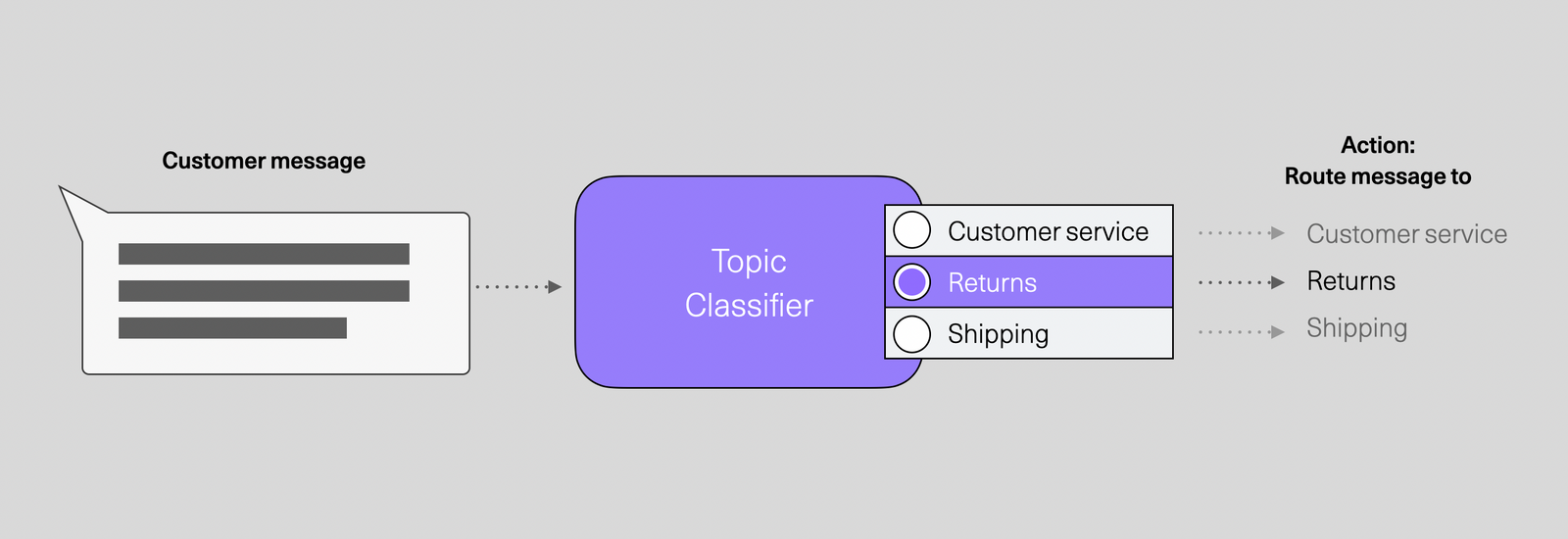 This routing can either be actually forwarding an email or integrating with Customer Service software (like Zendesk or Freshdesk) that assigns the relevant person to look at the ticket.
A more advanced system is one that can automatically answer frequently asked questions instead of routing them to agents to answer them repeatedly. This is a common use case for chatbots to handle.
Chatbots and intent classification
Section titled “Chatbots and intent classification”Modern chatbots can be used to answer commonly asked user questions.
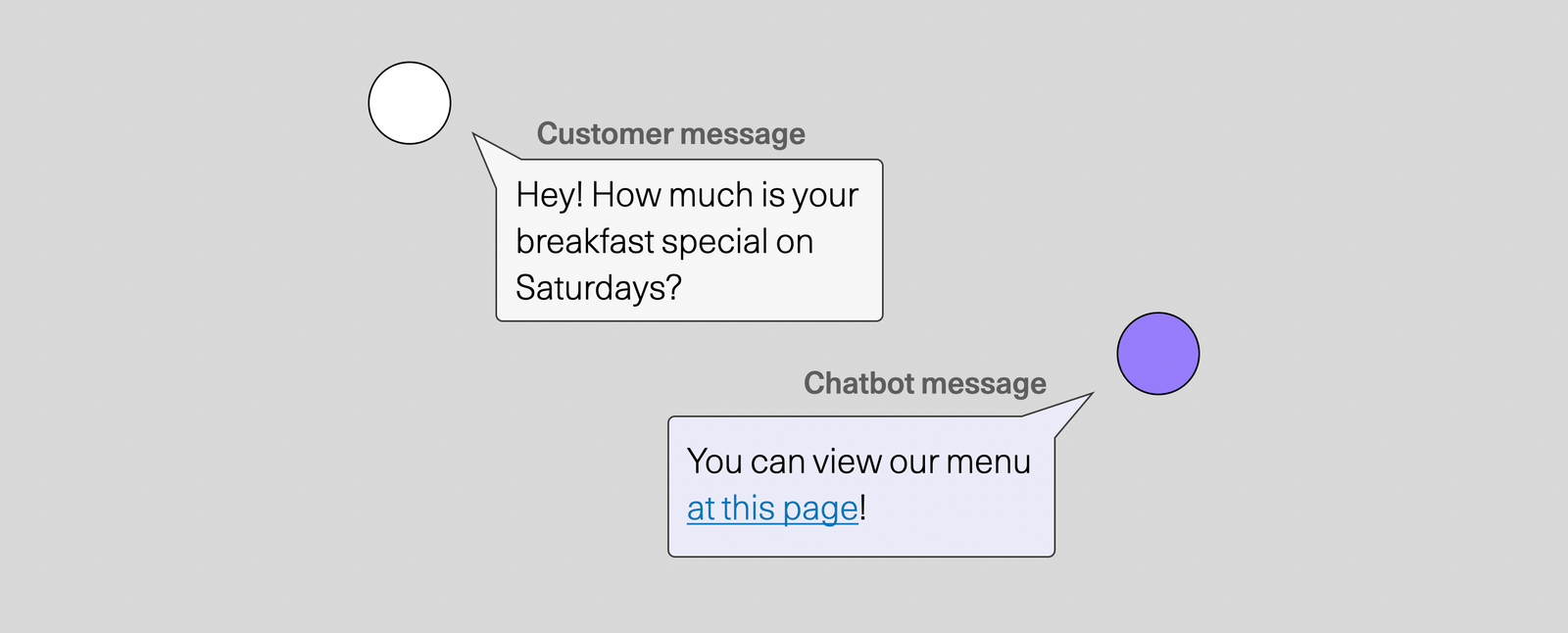 Text classification is a cornerstone of how these systems work. More specifically, most chatbots employ a classifier that detects the intent behind the user’s message. Intents are broader than topic classifiers as they include intents like “greeting” that enable them to react when a user says “hi” or “bye”, for example.
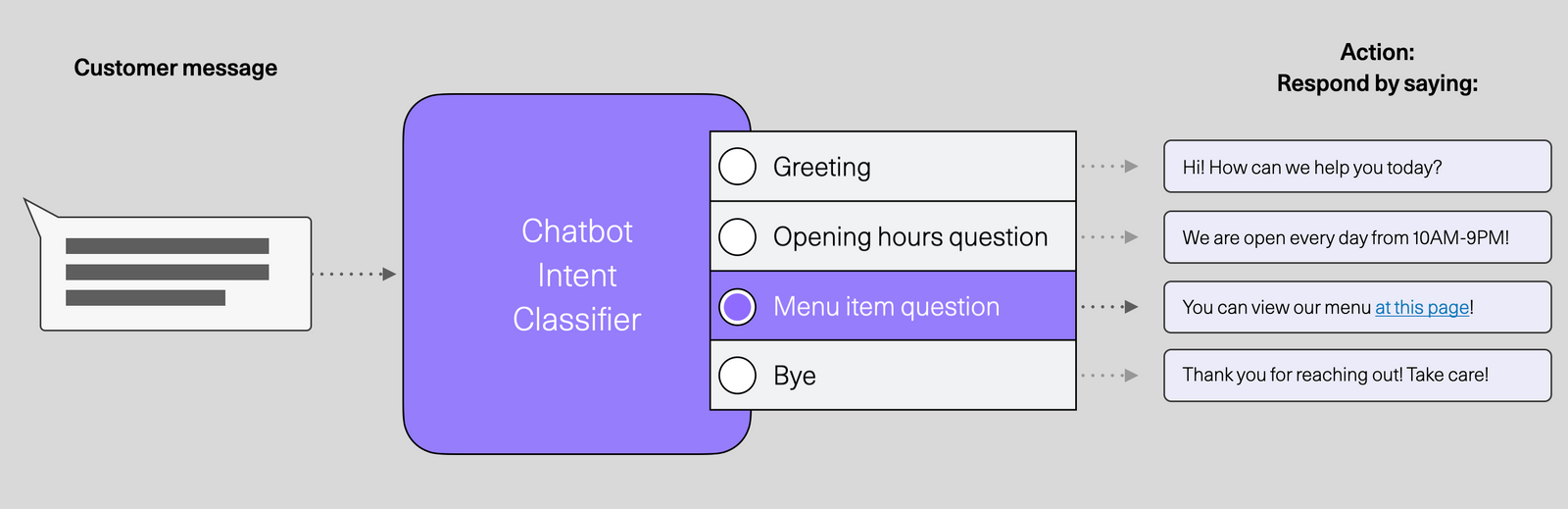 Chatbots tend to pair intent classifiers with entity extractors – another language processing functionality to extract the “breakfast special” from a menu item question so the system knows exactly which item the user is asking about.
Content Moderation
Section titled “Content Moderation”A significant portion of human interaction now happens online through social media, online forums, and group chats (like Discord or Slack). More often than not, these online communities need moderation to keep their communities safe from different types of online harm. Language understanding systems can empower moderation teams in combating toxic, abusive, and hateful language.
A content filter can classify texts as either neutral or toxic:
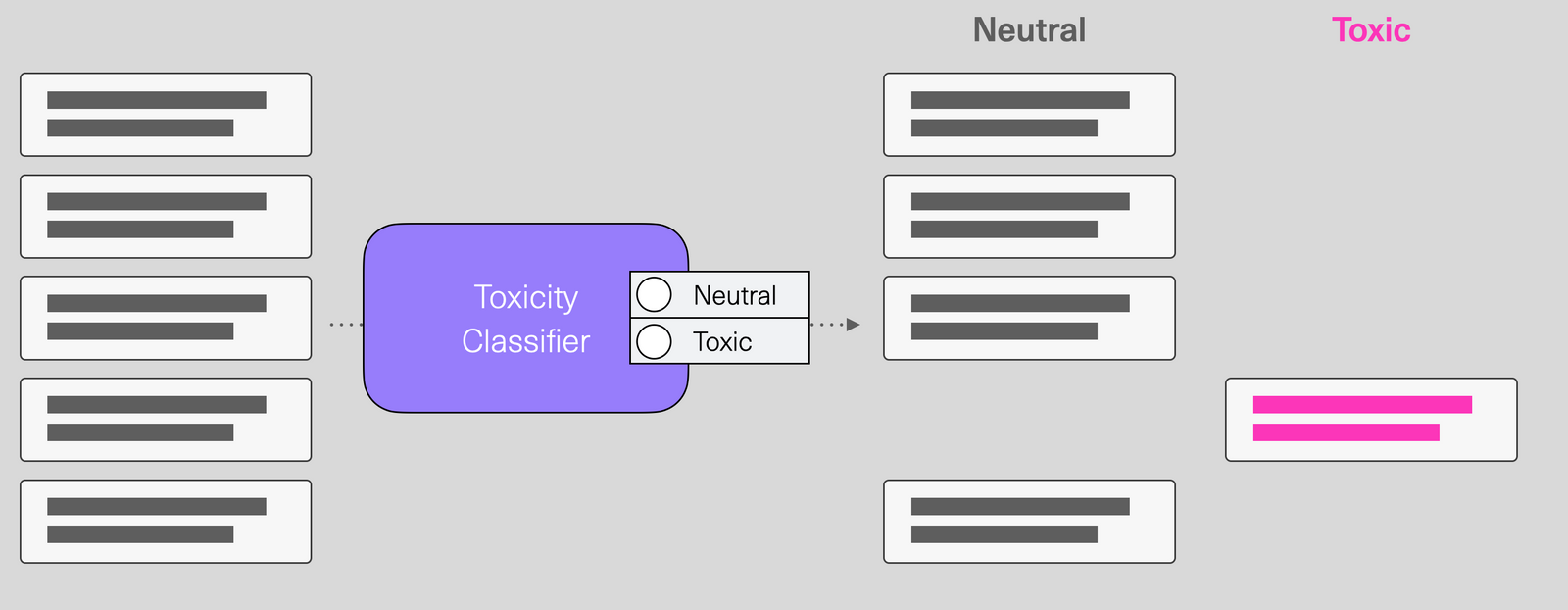 In [Content Moderation with Classify](https://docs.cohere.ai/classify-content-mod?ref=txt.cohere.com&__hstc=14363112.fb39cf5aec47995e64cd26603e2e04d9.1682489949734.1683571482981.1683573460217.34&__hssc=14363112.27.1683573460217&__hsfp=3887566761), we show how you can build such a classifier with [Classify](https://docs.cohere.ai/text-classification?ref=txt.cohere.com&__hstc=14363112.fb39cf5aec47995e64cd26603e2e04d9.1682489949734.1683571482981.1683573460217.34&__hssc=14363112.27.1683573460217&__hsfp=3887566761). This includes the ability to finetune a model on your labeled data so the classifier can specialize to solve this problem.
Other text classification problems
Section titled “Other text classification problems”Building the best classifier and evaluating it for a specific dataset is a deep topic with a rich history and plenty of ongoing work. But for a developer just approaching the topic, this article aims to communicate the intuition of how to think of text classification as a language understanding capability that can improve software systems that handle text and communication.
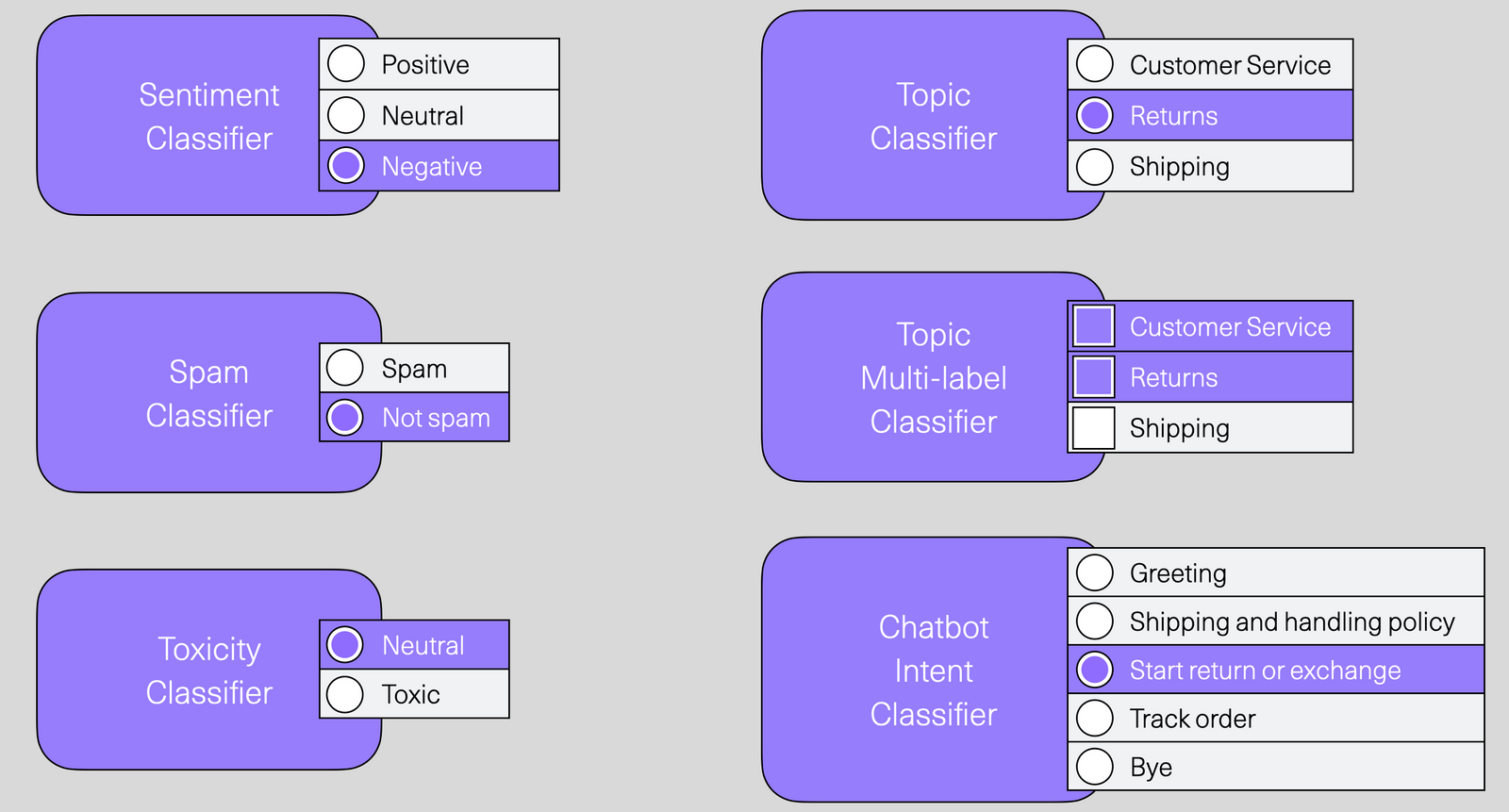 If you're able to map real-world problems to text classification problems, that's a good first step to start your path in creating language processing systems.
Conclusion
Section titled “Conclusion”In this chapter you learned what a classification model is, and how they can be used for numerous applications.
https://txt.cohere.com/text-classification-use-cases/
Original Source
Section titled “Original Source”This material comes from the post Text Classification Intuition for Software Developers